- Crypto 100x Blueprint
- Posts
- How I've Been Trading Stocks For Massive Profit
How I've Been Trading Stocks For Massive Profit
And how you can do the exact same thing with some new rules in minimal time

Dawson Allen
August 13, 2025
What if I told you that there’s a simple, repeatable formula for trading stocks so you can put your idle cash to work. There are only a few key rules that have to be followed, and you can start literally printing money out of thin air.
For example, I started with about $6,000 in May and now have over $8,000 at the beginning of August from this strategy. I know it might not sound impressive, but that’s about a 33% return on my total stock portfolio in 3 months.
Another way to put this is, “do you want to earn 10% per month on your stocks instead of 10% per year in the index”?????
I know I do.
Here’s the rules and then we will break them down each further:
Buy when a stock is close to or breaking its all time high
Buy at low risk entries such as cup and handle patterns
Learn to take profit at optimal levels
If you can do these 3 things, you will far outpace the majority of other investors who fail to compound their returns year over year.
Rule 1: Buy At All Time Highs
“I can’t buy at all time highs! By that time, all the gains are already done and I missed the opportunity.”
This couldn’t be further from the truth, the way most investors look at stocks is that you have two options:
Buy the bottom and ride it up
Buy the top and ride it down
But there’s really a 3rd option. Buy the top as an indicator that this stock is going much higher. In a bear market, the best stocks will not drop 30%, 50% or even 70%+. The best stocks might be 20% or less off their all time highs. What happens then at the beginning of a bull market is you have stocks breaking all time highs within a few months of the new market cycle. Does this mean that these stocks are bad purchases?
Noooooooo.
It means that they are the strongest, leading stocks that you need to get ahold of as soon as possible. What I have been doing is identifying leading stocks that are going up at the beginning of this current market move and riding those as much as I can.
Would you argue that Palantir was a bad buy as it broke ATH???? I’d say no.

PLTR Stock
What about Netflix. Should you have avoided it because it broke all time highs 4 different times?

NFLX Stock
This rule won’t always work, especially as the broader market indexes like the SPY and QQQ start rolling over at the end of a bull market start of a bear market, but if good times are just turning around, then the leading stocks will be breaking their ATHs.
Rule 2: Find The Low Risk Entry
“All stocks are risky. I feel like I’m just throwing cash at the market without any idea which way the stock will move.”
I have three words for you. Cup and handle. Every stock price can have a good entry if you can find areas to limit risk. There’s a few ways I do that to time optimal entries where the path of least resistance is straight up.
Let the moving averages catch up to the price
Find areas where volatility has decreased in tight areas
Only give yourself a maximum 10% loss
You can’t control the outcome of what the stock does. You can’t control the profit you make. You can control how much risk you take though.
Roblox stock entered a tight two weeks after a big move up. During this tight area, the 21 day SMA was capable of catching up to price allowing another low risk entry point. This is low risk because you can set your stop loss at the 21 day SMA price. If price drops below this level, then we know a bigger correction to the 50 day SMA is probably due.

RBLX Stock
Astera Labs had an incredibly tight couple of weeks recently where volatility contracted hard against the $100 stock price level. This total move resembles a cup and handle pattern with the cup extending down to about $47 before building out the handle right below $100. Another version of volatility contraction you can search is the VCP pattern.

ALAB Stock
Finally, only allowing yourself a 10% loss helps you to limit the damage that any one position can do to your total portfolio if it blows up on you. A 10% loss needs an 11% gain to get your money back. I typically will set stop losses to 5-7% for a tighter entry.
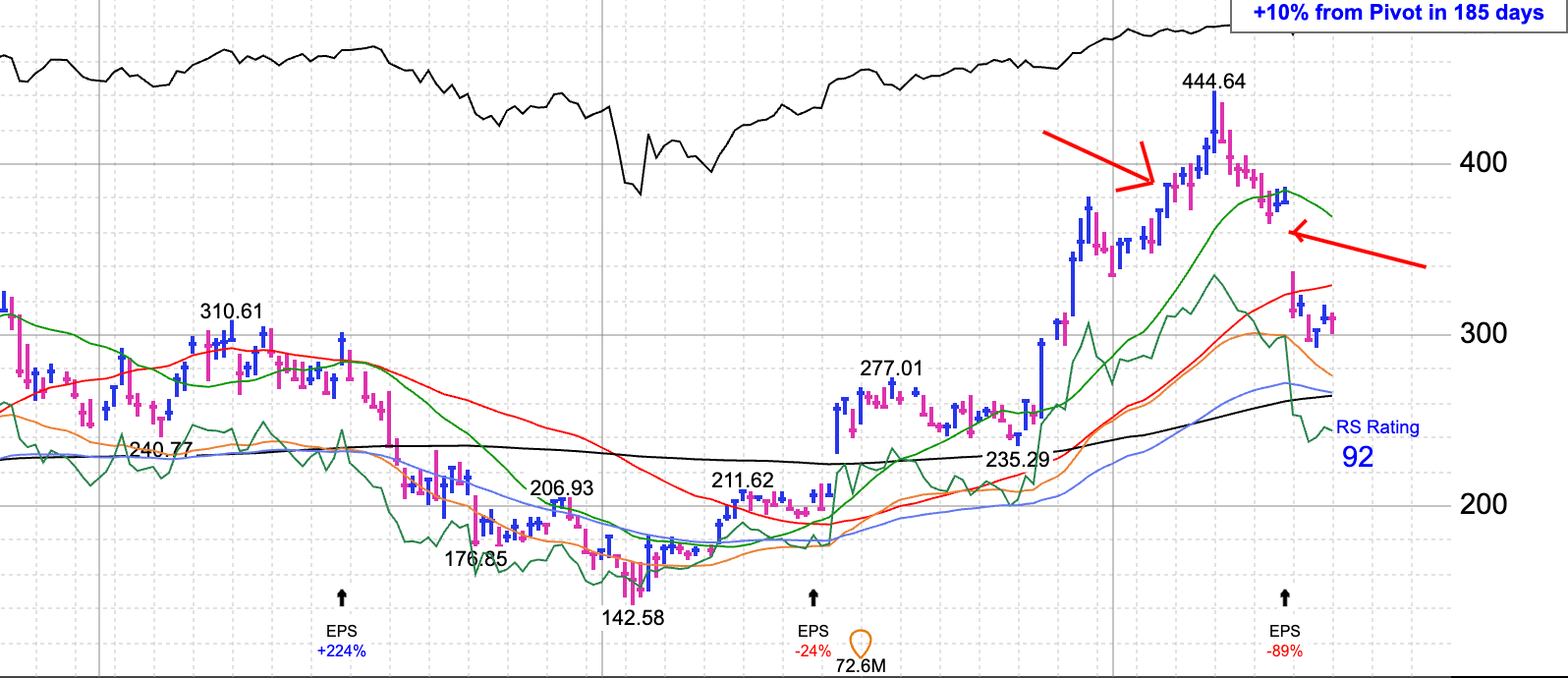
Below, I bought Coinbase on the first arrow. I was in profit over the next week, but then as price broke below the 21 day SMA, my stop loss was triggered and my position sold. Thankfully this happened because if it didn’t, I would have taken a much bigger loss as price broke below the 50 day soon after.
COIN Stock
Rule 3: Take Profit And Repeat
“I’m not taking my profit now. This stock is going much higher.”
Most often, a stock will move up about 20-30% before retracing a little. Sometimes, especially if you’re in the leading stocks, you won’t get a pull back, but often time stocks need a moment to cool down before continuing higher.
What does this mean? Basically, you should always be looking to take profit off the table when the going is good. This will help you to guarantee some profit to bankroll your next trade.
Below, you can see how Nvidia grew a ton over the past year, but it moved up in a few key stages. Each larger stage ran up about 20-30% before cooling down into sideways or retracement action before the next leg up.

NVDA Stock
The 25% profit taking rule is not a hard and fast rule to always follow. Some stocks might be so strong that you don’t need to take said profit. But it is always good to have a plan to pull some chips off the table and ensure you make money in this game.
Those 3 rules are my essentials to crushing it in the stock market. Trust me, they won’t always score you a winning stock pick, but they will help you stay in the game while you build up your intuition on what a good stock is.
With these rules, I have been able to ride amazing trades and get out of loosing trades with relative ease the past few months.
If you want to read more about these rules and similar rules, check out CANSLIM style trading and you’ll see what I mean.
Crypto isn’t always the place to be, and when stocks are working, I don’t think you should ignore them.
Thanks,
Dawson